
Made in India, Flowing Across the World: How Indian Valve Manufacturers Are Powering Global Infrastructure


Traditionally, valve production relied heavily on manual craftsmanship and mechanical testing. Today, however, Indian factories have transformed into high-tech ecosystems. Digital transformation in manufacturing has redefined every stage — from design to distribution.
Modern plants use automated process control systems, allowing precision machining with minimal error. Through industrial IoT applications, sensors continuously monitor variables like temperature, pressure, and material density during production. These insights help manufacturers predict potential defects long before they occur, ensuring reliability and consistency.
This digital shift has also boosted scalability. By integrating data-driven manufacturing practices, Indian producers can now adapt quickly to global demand — meeting tight deadlines without sacrificing quality. These capabilities are attracting international infrastructure developers seeking cost-effective yet technologically advanced valve solutions.
Smart Valve Technology: Where Engineering Meets Intelligence
The modern valve is no longer just a piece of hardware; it’s a networked, intelligent component within larger control systems. Through AI in industrial automation and IIoT (Industrial Internet of Things) connectivity, valves are becoming smarter, safer, and more efficient.
For instance, digital control valves are now equipped with sensors and actuators that automatically adjust flow rates based on real-time conditions. These devices communicate directly with smart control systems, minimising human intervention and reducing operational downtime. In power plants, chemical refineries, and wastewater facilities, such technology translates into significant savings — both in time and energy.
Moreover, the adoption of smart valve technology allows operators to gather valuable performance data. Predictive maintenance becomes possible, reducing unexpected failures and extending equipment lifespan. This shift toward intelligence-driven systems positions Indian valve manufacturers at the forefront of industrial valve automation on a global scale
Digital Twin Technology: Manufacturing in a Virtual Mirror
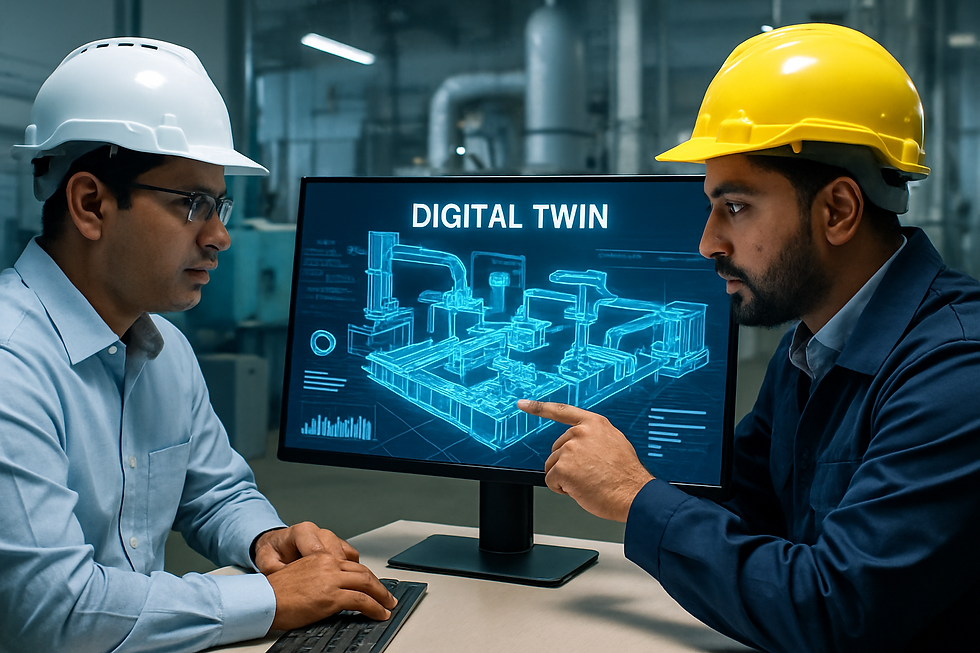
Another revolution reshaping this industry is the implementation of digital twin technology in manufacturing. Simply put, a digital twin is a virtual replica of a physical product or process. Engineers use these digital models to simulate, analyse, and optimise performance — long before a single part is built.
For valve manufacturers, this innovation is a game-changer. They can now visualise how a valve will behave under extreme pressures or temperatures. Adjustments can be made virtually, reducing prototyping costs and speeding up development cycles. Additionally, once deployed in real-world systems, these digital twins continue to feed data back into the design process — improving future iterations.
In large-scale infrastructure projects, digital twins also enhance integration with smart manufacturing solutions. They help engineers understand how valves interact with other system components, enabling predictive analytics that enhance reliability and efficiency across entire networks.
Automation and AI: Redefining Industrial Efficiency
Artificial intelligence is reshaping how industries think about production, monitoring, and decision-making. Within valve manufacturing, AI in industrial automation helps interpret data collected from IoT-enabled machines. This data is then used to forecast maintenance needs, optimise energy usage, and identify efficiency bottlenecks.
When combined with automated process control, AI-driven algorithms make manufacturing operations adaptive. Machines can independently adjust parameters to maintain peak performance. In the context of global demand and complex supply chains, such adaptability ensures that Indian valve manufacturers remain competitive while maintaining rigorous quality standards.
Made in India, Trusted Worldwide
Indian companies have steadily built a reputation for innovation and reliability. Their products now meet or exceed international certifications like ISO and API, aligning with the stringent requirements of global energy, water, and construction sectors.
What distinguishes India’s manufacturing ecosystem is its commitment to sustainability alongside technology. With rising awareness about environmental responsibility, many manufacturers are investing in eco-efficient production — reusing water, minimising waste, and adopting renewable energy sources within their plants. This aligns with the global movement toward sustainable infrastructure development.
One brand leading this transformation is Castle Valves, a recognised name in industrial valve manufacturing known for combining engineering precision with technological innovation. Their approach mirrors India’s broader industrial growth — merging traditional expertise with modern automation to serve a connected world.
A Digital Future for Global Infrastructure
The story of India’s valve industry is not just about manufacturing—it’s about transformation. As digital control valves, smart control systems, and IIoT-driven automation become integral to modern infrastructure, Indian manufacturers are no longer just participants; they are innovators shaping the flow of global progress.
From power generation and petrochemical plants to renewable energy and smart cities, valves engineered in India are quietly, efficiently, and intelligently ensuring the world keeps moving. The integration of data-driven manufacturing and digital twin technology ensures that future infrastructures are not just robust but adaptive—ready for an era where intelligence and precision flow together.
Shaping the Future: India’s Valve Industry at the Forefront of Innovation
The evolution of Indian valve manufacturing mirrors the country’s industrial renaissance—where digital technologies, automation, and innovation converge. As the world moves toward connected, self-regulating systems, the humble valve stands as a symbol of precision, resilience, and transformation.
From the heart of India’s factories to pipelines and power grids across continents, these valves are doing more than regulating flow—they’re shaping the rhythm of a smarter, more connected global infrastructure.


Comments