
What Is a Strainer Valve and Why Your Pump Needs One?
- Castle Valves

- 3 days ago
- 5 min read
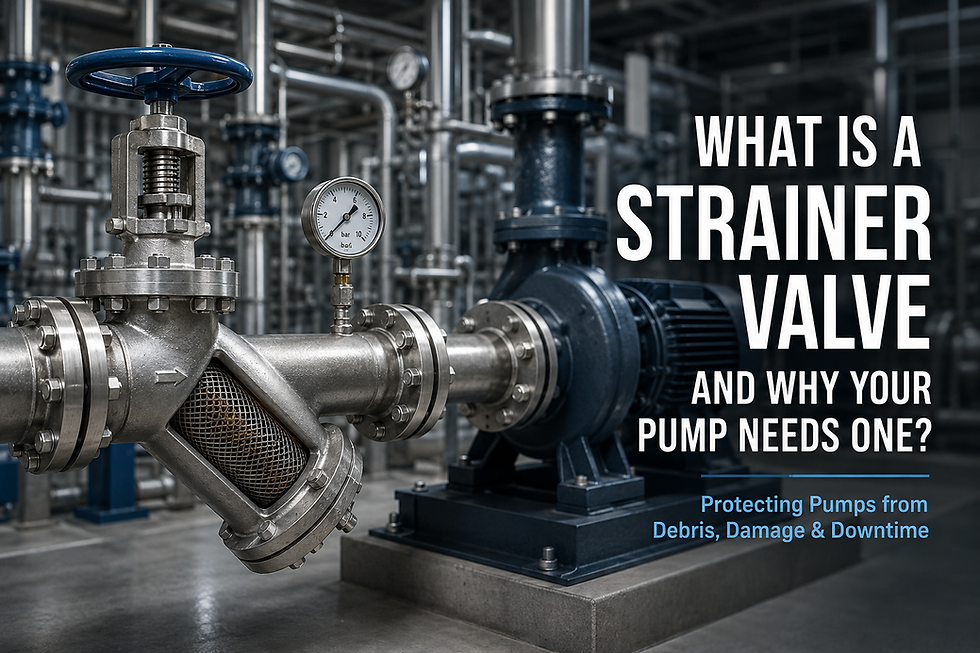
A strainer valve is a fitting with a built-in mesh screen that catches rust, pipe scale, weld slag, and other debris before it reaches a pump, ball valve, or control valve. It is installed upstream of the equipment it protects and is one of the cheapest, most overlooked ways to extend pump life and prevent unplanned downtime in HVAC and plumbing systems.
Most pump failures that look like a motor or bearing problem actually start upstream, with grit or scale wearing down impellers and seats long before anyone notices. A strainer valve is the simplest fix for that failure mode, and it costs a fraction of the equipment it protects. Here is what it does, where it belongs in your system, and how to size one correctly.
What Exactly Does a Strainer Valve Do?
A strainer valve filters solid particles out of a flowing liquid or gas before that fluid reaches sensitive downstream equipment. Inside the valve body sits a removable mesh screen; fluid passes through the mesh, debris gets trapped on the upstream side, and clean fluid continues on to the pump, valve, or instrument it is protecting.
The most common form in HVAC and plumbing systems is the Y-strainer, named for its angled, Y-shaped body. Castle Valves' Ball Valve with Strainer combines this filtering function directly with an isolation ball valve, so a single fitting protects the line and lets you shut it off for maintenance without adding a separate component.
Why Does a Pump Specifically Need One?
Because pump impellers, seals, and bearings are precision components with tight clearances, and even small particles circulating through a system can erode or jam them over time. A strainer installed at the pump suction line traps that debris before it ever reaches the impeller, which is the single highest-value placement for a strainer in any pumped system.
Prevents impeller wear from sand, scale, and grit
Stops debris from jamming check valves and seals downstream
Reduces nuisance trips and unplanned maintenance call-outs
Protects warranty claims many pump manufacturers require upstream strainers as a condition of cover
Where Should a Strainer Valve Be Installed?
Always upstream of the equipment you are protecting, and always with the strainer's basket or screen oriented so debris collects in the pocket rather than being carried further downstream. The two most common placements are at pump suction lines and directly ahead of control valves, PICVs, or solenoid valves with fine internal passages.
Horizontal lines: install with the strainer pocket pointing downward, following the flow arrow on the body
Vertical lines: only suitable for downward flow, so debris stays trapped rather than falling back into the line
Always pair with an isolation valve on each side so the strainer can be cleaned without draining the system
A small drain or blow-down valve on the strainer's lower port is a worthwhile addition it lets maintenance staff flush accumulated debris without removing the screen at all, which is the single biggest time-saver in routine upkeep.
How Do You Choose the Right Mesh Size?
Mesh size is measured as the number of openings per linear inch of screen a higher mesh number means smaller openings and finer filtration. The right choice balances two competing risks: too coarse, and debris passes through to damage equipment; too fine, and the strainer clogs quickly, increasing pressure drop and maintenance frequency.
Mesh Size by Application
Application | What It's Protecting | Typical Debris | Recommended Mesh |
HVAC / chilled water | Pumps, ball valves, PICVs | Pipe scale, rust, weld slag | 20–40 mesh |
New construction commissioning | Entire system, pre-flush | Construction debris, weld slag | 40 mesh, then relax to 20 |
Steam lines | Steam traps, control valves | Pipe scale at high velocity | 40–60 mesh |
Solenoid / control valves | Pilot passages, fine seats | Fine grit, sediment | 60–100 mesh |
A practical approach many contractors use during commissioning: start with a finer 40 mesh screen to catch construction debris and weld slag during initial flushing, then switch to a coarser 20 mesh for long-term operation once the system has been cleaned out. This reduces nuisance cleaning once the system is running normally.
What Happens If You Skip the Strainer?
Unfiltered debris travels straight to whatever component sits downstream, and the damage compounds quietly. Grit accelerates wear on ball valve seats and pump impellers; scale and rust can lodge in PICV cartridges and solenoid pilot passages, causing valves to stick or leak. Replacing a damaged pump or control valve typically costs many times more than the strainer that would have prevented the failure.
This is why strainers are frequently called out as mandatory in pump and PICV warranty terms manufacturers know that the device sitting just upstream is often the deciding factor in whether their equipment reaches its expected service life.
FAQ
What is the difference between a strainer and a filter?
In industrial piping, the terms are often used interchangeably, but “strainer” typically refers to a coarser mesh device designed to catch larger debris like scale, rust, and grit, while “filter” usually implies finer filtration for smaller particulates. A strainer valve is built for mechanical protection, not for fluid purification.
How often does a strainer need cleaning?
This depends on water quality and system load, but a pressure gauge on either side of the strainer is the most reliable way to know a rising pressure difference across the strainer indicates the screen is collecting debris and needs cleaning. New systems typically need more frequent cleaning in the first few months as construction debris works its way out.
Can a strainer valve be installed in any orientation?
No. Y-strainers in horizontal lines should have the pocket pointing downward, and in vertical lines they should only be used where flow moves downward, so trapped debris stays in the pocket instead of falling back into the line when flow stops.
Does a finer mesh always offer better protection?
Not necessarily. A mesh that is too fine for the application clogs quickly, increasing pressure drop and maintenance frequency without a meaningful protection benefit. The right mesh size matches the smallest particle size that would actually damage the equipment downstream finer than that simply adds maintenance work.
Specifying the Right Strainer for Your Project
A strainer valve is a small, inexpensive line item compared to the pump or control valve it protects, but skipping it or specifying the wrong mesh size is one of the most common ways procurement teams end up paying for avoidable equipment failures down the line. For HVAC and plumbing systems, matching the strainer and mesh size to what it is protecting is a one-time decision that pays for itself many times over in reduced maintenance and longer equipment life.
Castle Valves manufactures Ball Valves with Strainers for HVAC and plumbing applications, combining filtration and isolation in a single, forged brass fitting built for Indian working conditions. If you are finalising a pump station or valve schedule and need mesh sizing guidance or technical datasheets, our team can help you specify the right strainer for your application.


Comments